Commuter Rail Feasibility Study
A Community-Driven Conversation
For years, our community has asked an important question: Could commuter rail work here?
The Regional Transportation Commission (RTC) took that question seriously—commissioning a comprehensive feasibility study led by WSP, one of the world’s leading transportation consulting firms. The goal was simple: provide a clear, data-driven look at what it would take to bring commuter rail to our region.
Why Rail, Why Now?
The Tahoe Reno Industrial Center (TRIC) is a major economic engine—not just for Northern Nevada, but the entire country.
- One of the largest industrial parks in the United States, spanning over 107,000 acres
- Home to 100+ companies, including major employers like Tesla, Panasonic, Redwood Materials, and Walmart
- Supporting 20,000+ daily commuters, with that number expected to nearly double in the next 10–15 years
At the same time, planned NDOT improvements to I-80—beginning in mid-2027 and lasting more than five years—will significantly impact the only primary corridor connecting Reno-Sparks to TRIC.
Together, these factors create both a challenge and an opportunity.
What the Study Evaluated
The feasibility study explored the potential for commuter rail service using the existing Union Pacific Railroad corridor.
Key highlights:
- 22-mile corridor connecting downtown Reno to TRIC
- Potential stations in Reno, Sparks, and near USA Parkway
- Focus on serving commuter travel patterns, especially shift workers
What Could Service Look Like?
A near-term startup scenario outlines a practical, scalable approach:
- Three round trips in the morning and afternoon
- Approximately 30-minute travel time
This initial phase is estimated at approximately $175 million in capital investment.
Long-Term Vision
A full build-out would expand service even further:
- Extension to the Tesla Gigafactory
- Major rail infrastructure improvements
- A dedicated operations and maintenance facility
- Create additional UPRR mainline capacity for Workforce Rail and freight
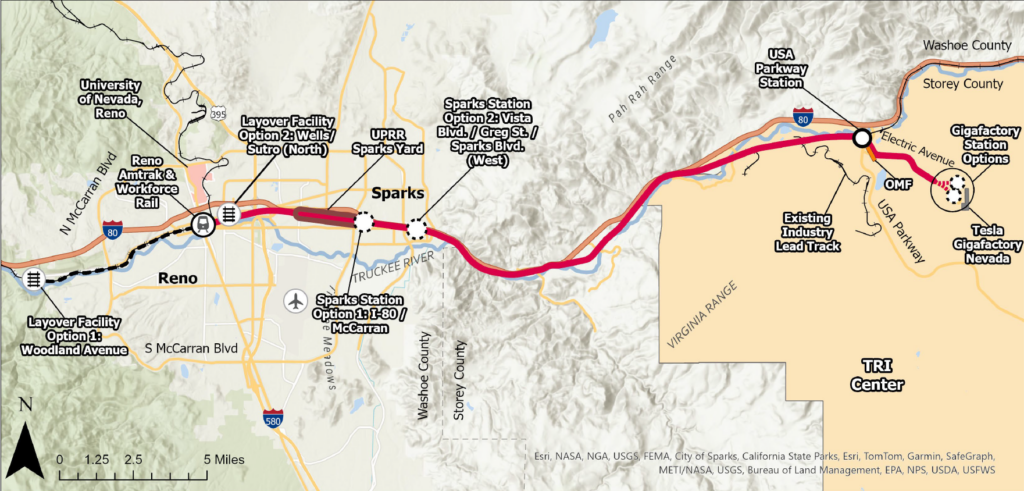
Estimated total program cost: over $900 million
Is There Demand?
Yes—and it’s significant.
The study projects:
- Approximately 14,500 daily riders during the I-80 construction period
- Strong demand driven by TRIC shift schedules and workforce growth
This demonstrates that commuter rail wouldn’t just be a convenience—it could be a critical mobility solution during peak demand years.
Where Things Stand Today
RTC has delivered what the community asked for:
- A thorough, transparent, and data-driven feasibility study
- Clearly defined options and costs
- Public access to findings
The question is no longer “Is it possible?”—it’s “How do we fund it?”
What Happens Next?
This is a regional conversation.
Commuter rail is achievable—but it requires meaningful investment and collaboration. Moving forward will depend on partnerships between:
- The community
- Elected officials
- Public agencies
- Private-sector stakeholders
Together, we can determine whether commuter rail becomes part of our region’s future.
